If you have a book you’d like considered for a review in Light—one that includes a large helping of comic verse and was published within the previous 12 months, or will be published in the next eight—please send a copy to:
Barbara Loots
4741 Central St.
Ste. 601
Kansas City, MO 64112
(Pre-print-run electronic copies may be sent to lightpoetryreviews@gmail.com)

Light on Their Feet
Reviews of books by Charles Ghigna, David Hedges, Daniel Klawitter, Susan McLean, David J. Rothman, and John Whitworth
by Barbara Loots
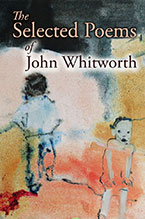
The Selected Poems of John Whitworth, by John Whitworth. Able Muse Press, 2026.
If you’re weary (as I am) of wading through reams of new poetry that’s merely solipsistic prose chopped into short lines, you may find exhilaration in the poems of John Whitworth. Huge intellect and erudition sublimely rendered in magical, metrical verse will salve your spirit. And possibly make you grieve that Whitworth moved away from this world in 2019.
So we go on, my soul and I,
Until the day I have to die.
He packs his bag, puts on his hat
And leaves forever, just like that.
(from “The Soul”)
Happily, Whitworth left a considerable legacy of verse, the best of which comprises the selected poems in this new book. I’m reading it during the month of my eightieth birthday. My stretch of wonderful life collides with the reality of living past my “Use By” date. Every day, it seems, celebrities like Dolly are dropping off at eighty. Whitworth, like no one else, captures this emotional rollercoaster in rollicking wordplay that may be infectious.
In “I’ll Be True,” he concludes:
Life is precarious, random and various,
Probably fatal, but possibly not.
Too much analysis causes paralysis[.]
All we can say is it’s all that we’ve got.
In his Selected you’ll find tenderness and sarcasm, grief and good humor, fact and fantasy, coming at you in a firehose of crafted verse. Historic, scientific, and literary references abound in poems like “Natural Selection,” “Rousseau and the Lion,” “Dr. Donne Likened to My Cat Jack,” and “The Oakshott Upshot.” He explores spiritual mysteries in “The Examiners” and in “Holy Shark,” an incantation that concludes the collection. Poems to and about his daughters offer advice (“A Birthday Present”) and glance off a father’s fears (“The Tower”). Imagine the story he tells in “Crash Driver Had a Cat on Head Court Told.”
The verse is brisk. But you’ll surely slow down to think about it. The poems will stick in your head.
If you’re already a fan of John Whitworth, or if you’ve never met him, you’ll probably want to have this book in your library.
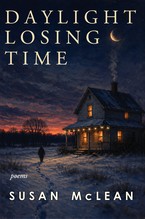
Daylight Losing Time, by Susan McLean. Able Muse Press, 2026.
Here, from Light‘s submission guidelines, is a quick intro to what this magazine welcomes:
We’re open to work from the left or the right,
to formal or free verse, refined or with bite,
to thought that’s like ours or that’s different by half:
we just want good stuff that’ll make people laugh.
Then, along comes a book that never once made me laugh. But…
Oh, how deliciously it plumbs a depth of dark humor in sonnets, villanelles, rondeaux, and other irresistible forms. In the blurbs, Dick Davis calls it “incisive mordancy, technical brilliance, and emotional intensity.” That would be the turf owned almost exclusively by Susan McLean, a poet with an impressive list of publications, prizes, and literary credits.
It’s hard to pull snippets from these tightly woven poems, which often have a jab at the end–or are too subtle to sort out in an excerpt. In “Secretary of the Interior” (one in a series of short poems titled “A Poet’s Garden of Vices”), the poet turns the mordant eye on herself and her art:
We sit on an island, Pride and I,
and gaze at a page, in which I see
how—with each bend and trim and lie—
I’m shaping myself, like a bonsai tree,
to be the fairest of them all:
twisted and perfect and very small.
Life holds disappointment and rejection, as noted by the poet taking her shot in “Heartthrob”:
For you, my dear, I will not bake a cake
or pen a schmaltzy valentine this year.
My heart’s stuck full of pins. I feel it ache
for you my dear.
So, keep it as a bloody souvenir.
I know it will take more than one to slake
your thirst, so ravenous and cavalier.
I do not need it pooling its small lake
of crimson stains or pounding in my ear.
But if you have a heart, I have a stake
for you my dear.
Titles like “The Other Woman,” “The Art of Leaving,” “The Elusive Typo,” and “Vanillanelle” are clues to the wit and cleverness in a book of poetry you simply can’t put down.
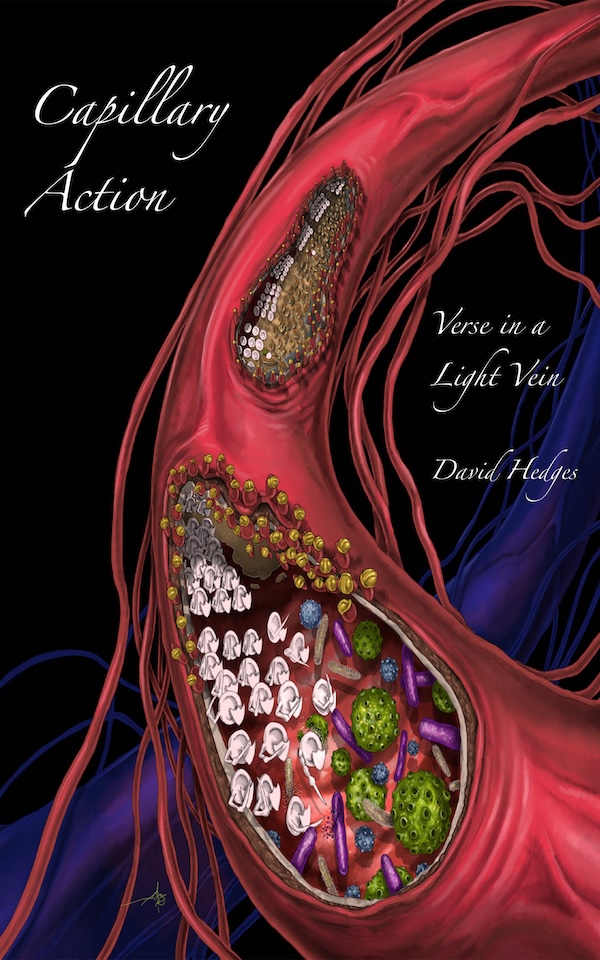
Capillary Action: Verse in a Light Vein, by David Hedges. Road’s End Press, 2025.
David Hedges qualifies as master of light verse. Numerous poems in this collection have appeared in Light and in other prestigious publications. In Capillary Action, more than one hundred pages of verse provide ample proof that “all the fun’s in how you say a thing,” as Robert Frost famously said. It’s one hundred per cent funny and fun to read out loud.
The collection is sorted into eleven chapters, among them Events & Affairs, Gravity & Greed, Love & Lust, Business & Pleasure, and Politics & Bureaucracy. In an appendix, a glossary of Terms & Forms serves as a valuable short course in versification.
You’ll find classic light-verse skills in every poem. There are flawless ABAB rhyme schemes and clever rhymes (schlemiel/wheel, back lots/crackpots, fraud/roughshod, metal rock/chicken stock/chockablock). There’s a ballade with four rhymes for “Cyrano’s.” Limericks: check. Epigrams: check. History of the planet in nine stanzas: check. Here’s a snippet from “No Sooner Soup Than Nuts”:
No sooner the soup than the protoplasts
As clouds commenced to hurl their lightning bolts,
Stirring amoebae to their light repasts,
The shocks enough to cause iconoclasts
to bond. Don’t ask how many watts or volts
It took to make the goop electrified.
Those single cells soon swam about in schools.
You know the rest: First they learned to divide;
Then, not content with that, they multiplied;
Before long, the brains were packing slide rules.
Although “brevity is the soul of wit”—especially in humorous verse—Hedges sustains the hilarity in longer poems and in “serious” measures of terza rima, aubade, and villanelle.
“A Guide to the Modern Sonnet” aims a critique at the erosion of classic standards.
Erase old-fashioned notions from your mind,
Frivolities like rhyme, unless it’s slant,
And meter, because meter is a grind—
A kiss of death when going for a grant.
His social-criticism arrows are sharp, too. For example:
Blue Moon
“Water Ice Detection Delights Lunar Researchers”—Space.com
We knew the Moon was made of green cheese once
And anyone who differed was a dunce.
Then came the knowledge that the cheese was rock
And meteors accounted for the pock-
Marked plains and craters. Ah, but then we struck
A source of drinking water—pure dumb luck.
Last night I heard the water rights were sold
And when I looked, the Moon had turned to gold.
Good Little Shoppers
We got along fine before Walmart
Made Main Street a thing of the past.
Then Amazon filled up our e-cart
And left even chain stores aghast.
The trend toward consumer eavesdropping
Reduces our choice of commodities.
We find as we go about shopping
A shortage of off-branded oddities.
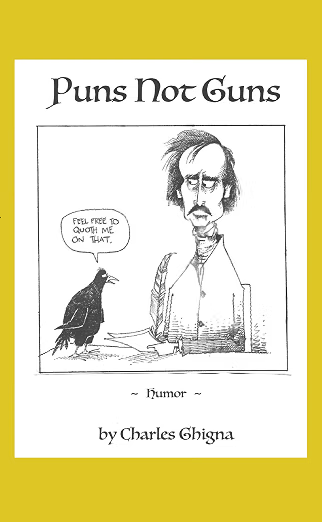
Thanks now to electronic spying Of course, there are love poems. Oh You! You are my joie de vivre, dear, You are my tenor saxophone, You are my cakes and ale, true-blue, The late, great X.J. Kennedy declared, “I’m a Hedges fan for life.” Me, too. Puns Not Guns, by Charles Ghigna. Livingston Press/University of West Alabama, 2025. A one-man industry of verse, Charles Ghigna sometimes styles himself Father Goose. Puns Not Guns is for chuckles, but not for children. Widely published in newspapers and magazines, Ghigna has been nationally syndicated. He lists twenty-one books published since 2018. Chances are you’ve encountered his pithy and impertinent poems already. This collection is divided into twelve topical sections, beginning with Politics and ending with Faith & Inspiration. Though Ghigna writes for humorous effect, he has his thoughtful moments, too. As you may surmise, 300 pages of four-line verse have something to say about, well… almost everything. The pun’s the thing in these (perennially) topical examples: The Passing of an Error Our past mistakes may come and go, Political Draw Politicians often dwell Throughout the twelve sections, wisdom and wisecracks abound: Starting Next Sundae The urge to diet comes and goes Body and Soil I’ve worked the weekend pulling weeds. Fellow poets will relate to his poems on writing: Choice Language A synonym is just a word My Cussed Computer My cursor’s frozen on the screen. Ghigna notes that writing funny verse isn’t as easy as it may seem: Re-Verse The final draft upon the screen. Truth, right? For more fun, inspiration, or mere distraction, just dip in. Palm-Sized Poems, by Daniel Klawitter. 2026. This chapbook comprising some twenty-four poems fulfills its promise: brevity. The collection, dedicated to the late Anthony Harrington, is intended as a defense of light verse. The poet introduces himself in numerous photos, which include his cats, Daniel, Chekhov, and Hex. Many Light readers will relate to “The Old Poet Laments His Declining Poetic Output”: The poems used to flow quite quickly As a Brother in the ecumenical Order of St. Luke, Klawitter occasionally presents a point of view against religious hypocrisy, as in this snippet from “We See Thee, Whited Sepulcher”: On Sunday he sings: His subjects are not all light. The forms are entertaining. The cover illustration is an astonishing 19th century religious painting of a bleeding palm displaying five finger-puppet saints, among other things. That image alone might be worth pondering in your poetry library. And now for something completely different. David J. Rothman opens this collection with an essay, “On the Fortunes of Public Poetry.” He tells us that he wrote all of these poems for a public forum. A one-time Poet Laureate of Colorado’s Western Slope, Rothman has also served as Resident Poet for Colorado Public Radio, writing on commission about specific topics. You don’t have to live in Colorado to appreciate his subjects. His “transmission” is meant for all humanity. Of the laureate’s work, he says, “[S]uch poetry can be a form of witness, a single voice… to tell the complicated story of our lives together.” As he lightly boasts, “… I was one of the very few poets alive writing verse on deadline for money….” Written for the moment, the poems do, as he hopes, “stand up… to the passage of time.” In his prologue poem, Rothman writes, “You Can’t Dance to the News.” Yet he manages to deliver both news and music (word music) for the dance of everyday experience. Needless to say, a sense of humor is a significant job requirement. Having spent forty years composing verse for Hallmark, yours truly can relate to the challenge of speaking the public mind—or heart. In “Be My Valentine,” Rothman points out people’s need to seek out a spokespoet: Those who think poetry is dead, An important element of humor is, of course, clever word play. Rothman handles it craftily. In “Pay Your Taxes,” he takes rhyme to the pinnacle: When it comes to money, we all learn Off and running, he delivers thirteen more rhymes on the word taxes. I dare you to try this at home. Despite current political shenanigans, we are assured in “Let’s Have Real Debates Again” that there’s nothing new under the sun. A snippet: There they stand in glorious array To our democracy, we are invited Plus ça change. “New Year Letter 2017: Doggerel for the Inaugural” delivers five pages of commentary reminding us that what was happening then is still happening now, with different names and only slightly different facts. I’d love to quote the whole of “Poetry Matters,” but, like most poems in this collection, it goes on for quite a few lines. Rothman says, …it’s hard to describe why there’s magic in verse. Indeed. The droll and the dreadful are sublimely admixed in this collection. Although Rothman wrote many of these poems for particular events and venues, they transcend the original moment to inform and entertain us in the eternal NOW.
Retailers can compound their greed.
Too often we find ourselves buying
Whatever they tell us we need.
The sunrise to my chanticleer—
For you inspire full-blown desire
As if it were your life’s career.
My clarinet, my slide trombone—
The Dixieland of my jazz band,
My Downbeat and my Rolling Stone!
My cup of tea, my saucer, too—
In sum, the dish of my last wish,
My ripe Chablis, my oyster stew!
Though some are prone to stay.
A lesson that we fail to learn—
Until election day.
Inside their own delusions.
Every time they get the facts,
They draw their own confusions.
Until it’s finally gone.
It’s what we all keep putting off
While we keep putting on.
I’m hot and feeling foul.
Our garden still looks like a mess—
I’m throwing in the trowel.
That we have chosen well
Or one we like to use in place
Of one we cannot spell.
My mouse is stuck like glue.
Another glitch and soon I will
Become a cursor too.
At last my poem’s through.
A verse of only four short lines—
I re-wrote twenty-two.
But lately they’re slow and sickly.
And though the Muse has not withdrawn—
She doesn’t speak so much as yawn.
“There’s a Wideness in God’s Mercy.”
But Monday will bring
A brand-new controversy….
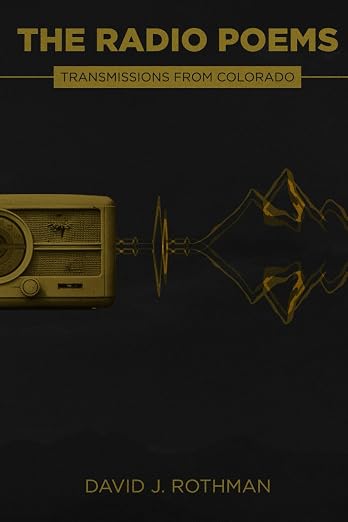
The Radio Poems: Transmissions from Colorado, by David J. Rothman. Middle Creek Publishing and Audio, 2025.
Who like to argue that all art has fled
To YouTube or the movies or dull prose,
Will still go out and buy a red, red rose
And scratch their prosy heads for words to say
That might do more than prose on Valentine’s Day.
That there is theory and then… there is praxis.
We all spend what we worked hard to earn,
And then there is the cold hard fact of taxes.
Next to their little desks, prepared to speak.
The lights come up, the camera pans away,
The crowd applauds, and in a scene unique
To listen to the flower of our nation
Address a crowd apparently delighted
By scandal, fear, rage and exasperation.
Just think, for example, what it does to a curse.
It’s one thing to yell out an insult in prose,
But poets can do so much better than those.
For the prose writer merely bends diction and grammar,
But poets have meter that smacks like a hammer.
And we’ve got the same words, but we also have rhyme,
Which can turn a mere quip into something sublime.“