If you have a book you’d like considered for a review in Light—one that includes a large helping of comic verse and was published within the previous 12 months, or will be published in the next eight—please send a copy to:
Barbara Loots
4741 Central St.
Ste. 601
Kansas City, MO 64112
(Pre-print-run electronic copies may be sent to lightpoetryreviews@gmail.com)
Light on Their Feet
Reviews of books by Austin Allen, Dan Campion, Martin Elster, Rhina P. Espaillat, Richard Meyer, Leslie Monsour, and Chris O’Carroll
by Barbara Loots
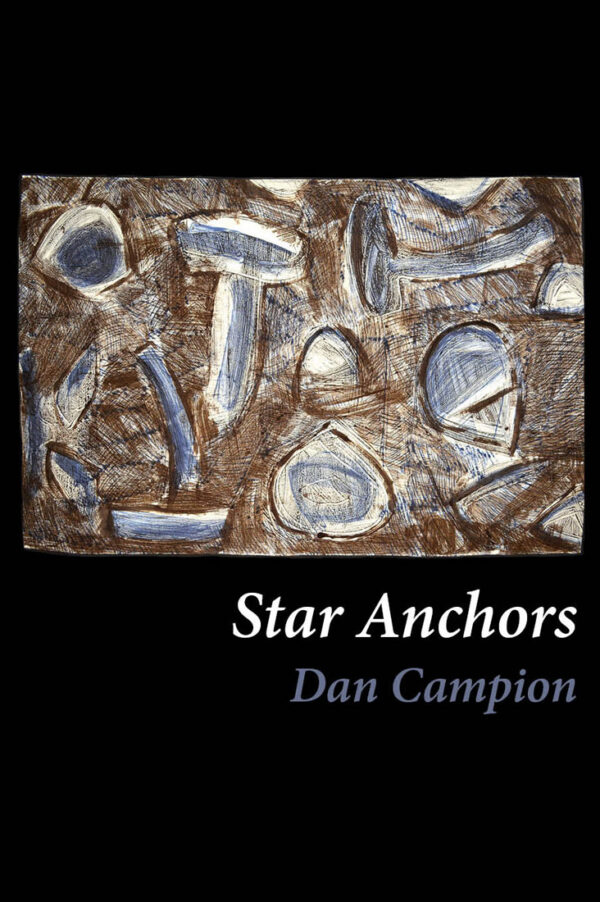
Star Anchors, by Dan Campion. Ice Cube Press, 2026.
Dan Campion has provided entertainment in Light on many occasions in both regular issues and Poems of the Week. The promotional flyer for Star Anchors promises “fifty years of poems gathered for the first time….” So now you can catch up.
The poems are presented in chronological order from 1975 through 2024. For each poem, Campion notes the date of the first draft and the date of first publication. His acknowledgements list notes publications in 48 poetry magazines and other media, many of them familiar to Light readers. To this reviewer (whose poetry writing career covers about the same time span) that is impressive record-keeping as well as significant creative achievement.
With scenes and stories, Campion takes the reader through more than five decades of life. He reflects on everyday things: a shopping cart, a desk drawer, a chain link fence, a circus poster. In “Hastings, Nebraska, 1920,” he tells about a man who wants to sell his wife. He invites you to join the regulars on Friday nights at “Jim’s Used Books.” The writing seems casual, effortless, while he tickles your ears with rhyme and near-rhyme, as in “The Survey”: juncture/nature, themselves/dissolves, rubble/stumbles, home/gone. Turn each page, and take a fresh look at, say, paperweights or the moon or an old-fashioned pharmacy.
Among the seven poems in this collection previously published in Light, from 2024 you’ll find an homage to Wallace Stevens titled “The Idea of Order at Key School,” which represents Campion’s delight and skill with the sonnet form:
At Francis Scott Key School we stayed in line,
except for Fred and Matt and Jimmy, who,
oh, yes, and Scott, would make wild serpentine
digressions from the strictly straight and true.
The rest is here.
Another sonnet with a whimsical tone appeared the same year in Lighten Up Online:
The Wizard of Nods
I often fall asleep at movies, doze
off with a book spread open on my lap.
No, these aren’t signs of age. The traits arose
in childhood. My first passion was to nap.
I’ve tried to solve the puzzle why that was,
but every time, it puts me on the nod.
I found the world harsh. Everybody does,
not everyone makes Morpheus their god.
I woke up long enough to go to school,
to hold a job, to marry, and to thrive.
But ask me how Shane ends, who fought a duel
with Death, who took Cannoli for a drive?
Search me. But soon enough you’ll hear a snore
that says, “We’re not in Kansas anymore.”
As a poet anchored in the Midwest, Campion explains in a note that a star anchor is “a plate of iron or steel cast in the shape of a five-pointed star that is connected to a tie rod internal to a masonry building so as to prevent lateral bowing of the walls. Star anchors are therefore both decorative and functional.” I take that as a metaphor for the various poetic forms Campion constructs in his impressive lifetime collection.
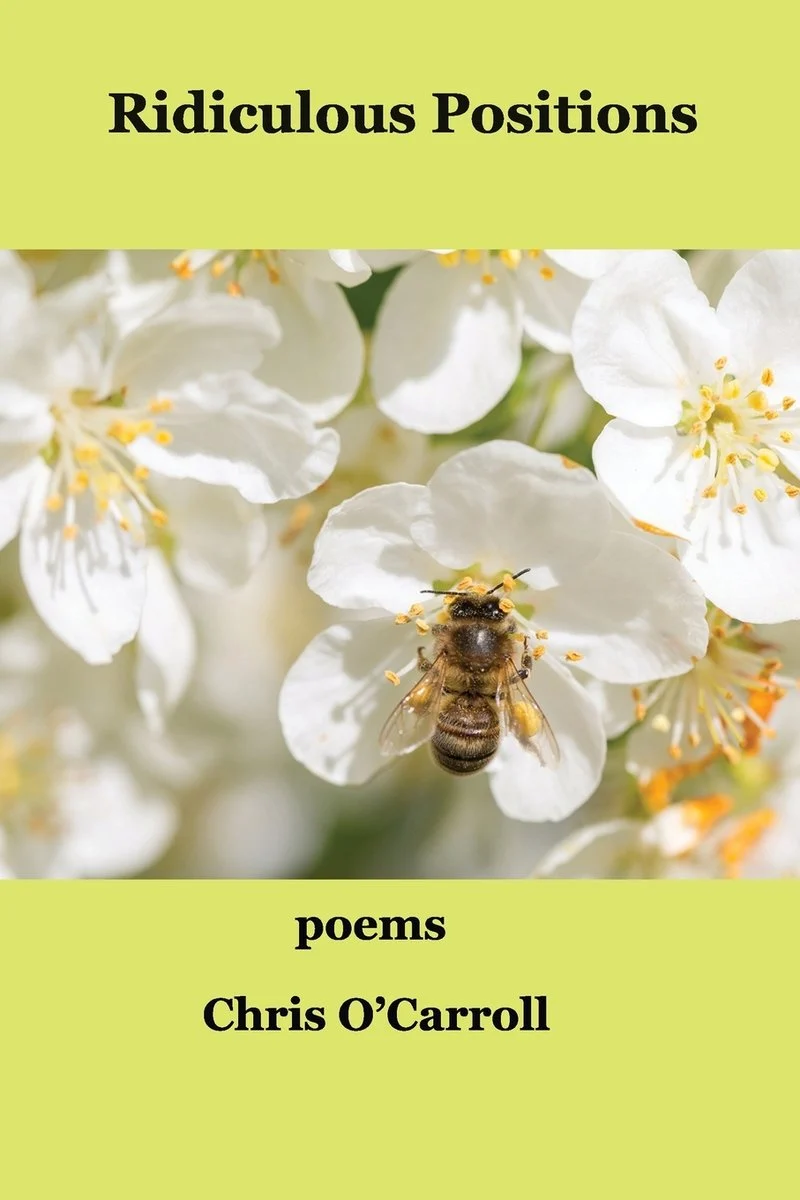
Ridiculous Positions, by Chris O’Carroll. Human Error Publishing, 2026.
Chris O’Carroll* needs no introduction to readers of Light, where 20 of the poems in this new collection first appeared. For the rest of its 90 delightful pages, O’Carroll brings on the best of his wit and humor. He’s a master of rhyme and meter and form. He chooses subjects from Marvel heroes to human foibles, from artistic life to animal life. He delivers acute observations, often with charming goofiness. Commenting on a nature study, he writes in “Juiced”:
Fermented fruits and berries get a skunk
Soused as a, you know. Cedar waxwings die
When they crash into fences flying drunk.
Red tooth and claw, meet nature’s bloodshot eye…
On the subject of intoxication, the epigraph for “Rodent Stoners” informs us: “Rats in northern India have been accused of eating hundreds of kilograms of cannabis seized from drug dealers and stored in police warehouses. —CNN 2022.”
O’Carroll elaborates:
Cops confiscated weed and tried to store it,
But hungry warehouse rats were jonesing for it—
Or that’s what court officials have been hearing.
Why else would contraband be disappearing?
The book comprises seven sections. The first, “To My Body,” is the poet’s personal disclosure. He invites us to join him in taking perhaps the best medicine, laughter plus irony. Here’s the shortest of the four poems:
Medical History
I’ve lost some weight since the operation.
I’ll still say yes to the odd libation.
But to nurse my liver, I’m drinking less.
Having cancer is good for me, I guess.
Cheers to you, Mr. O’Carroll.
Then he carries on in a veritable romp through forms and subjects, covering topics from getting buzzed to getting bedded:
Love’s Logistics
There may come a time when sex
Seems too dauntingly complex.
Be we gals or be we guys,
It’s a lot to organize.
All that energy and sweat
Might dampen lust. It hasn’t yet.
Cheers again!
In the section titled “Imitations,” O’Carroll brings us fresh and feisty takes on Wallace Stevens (“The Emperor of Birthday Cake”), Philip Larkin (“This Be the Family Therapist”), Emily Dickinson (“Sorting Laundry in Amherst”), and, for cruise fans or non-fans, John Masefield:
Sea Heaver
I must bend over the side again and spew out a meal or three.
The sea goes on giving this ghastly gift, and I give it back to the sea.
And all I ask is a steady deck, so my skin doesn’t prickle and pale,
And no queasy lurch undoes my gut and drapes me over the rail…
Happily, you’ll feel only good about the feast of forms he provides. You’ll find clerihew, limerick, double-dactyl, sonnet, nonce, and free. The title poem, “Ridiculous Positions,” is a knockout Fibonacci, a mathematical form explained in the End Notes. You might want to try it yourself.
For the world traveler, O’Carroll offers this word of warning in “Prague Proverb”:
Our Czech guide shares this advice
For fungi hunts:
“All mushrooms are edible.
Some only once.
For fun with rhyme and spelling, you’ll want to check out “#MoiAussi,” which begins with the name of the famous (or notorious) actor Gérard Depardieu.
In sum, for whatever’s afflicting your spirit these days, I prescribe Chris O’Carroll.
* Like the rest of Light’s staff, I was saddened to learn that Chris died on June 9, 2026, just days before this review was to appear. I send my heartfelt condolences to his family, friends, and many bereft readers.
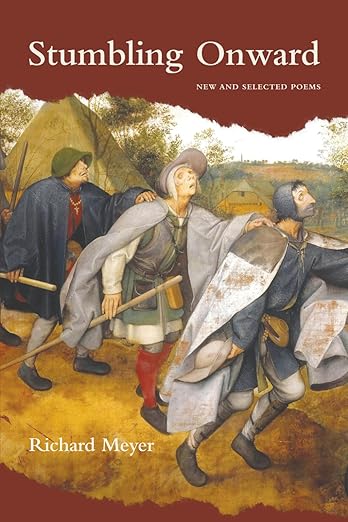
Stumbling Onward: New and Selected Poems, by Richard Meyer. 2025.
A Richard Meyer poem appearing on Robin Hedwig-Larsen’s Form in Formless Times prompted me to ask for a review copy of his latest collection, Stumbling Onward. The cover illustration, an evocative painting by Peter Bruegel the Elder, is itself a noteworthy addition to your poetry bookshelf. The contents follow through, with a sharpness and tenderness so interwoven I would sincerely like to sit down with the poet and a bottle and compare notes on our respective lives. For now, I’m pleased to settle in with just the poetry (and the wine). To begin:
Sapiens
By evolution born and bred
with something extra in the head
(and maybe also in the heart)
that sets us markedly apart
from all the teeming life on Earth,
we sapiens, for what it’s worth,
create and feel and comprehend,
but to what purpose, to what end?
Wisely foolish, cruelly kind,
with jumbled passions, muddled mind,
we’re oxymorons through and through.
In what we do or fail to do
a pestilential gifted ape
with a history we can’t escape.
Our future tenuous and stark,
we stumble onward in the dark.
Light is a theme throughout the book, from the light of stars to the light of fireflies, the light of science (“Immaterial,” “Black Hole,” “Time’s Arrow”) to the light of literature, art, and mythology. From “A Telling Light”:
…here beneath the spangled vault of night
I lie upon my back and still insist
that there must be a single telling light.
He claims not to be gifted as a “nature poet,” as in “Unschooled,” but he sees and he listens.
Meyer’s first book, Orbital Paths, was reviewed in Light by Barbara Egel in 2016. With a search, you can find his poems published in Light, which I’ve deleted from my selection here. I recommend you read them. Meanwhile, I bring you up to date on what Mr. Meyer has chosen to represent his legacy. For example:
Taking Stock
I’m neither odd nor eminent,
not come from hell, not heaven sent—
I’m past the three score years and ten
allotted to the race of men
and totter onward to my end
without the skill to comprehend
the why and wherefore of it all.
Though I’m inept and very small
within this world and universe
my little life is none the worse
for lacking great ability.
To be is good enough for me.
Modesty in a poet is admirable. Many of us past the age of three score and ten realize that to be is not only good enough, it’s pretty much all there is. Meyer rarely stumbles as he shows us an overview of a lifetime where cynical does not mean sourpuss and the heart doesn’t give itself up to the head. He’s making the most of traveling through:
Itinerant
When paper-shuffler death
comes mincing in the room
to settle up affairs
I’ll push aside the earth
and rise above the moon
and set out for the stars
unlodged from doubt and faith,
light traveling on my own
with love’s red-shifted scars.
The poems appear in chronological order, with the date of the first draft followed by the date of publication. (I wish I had been that organized over the past six decades!) Nowhere does Meyer list the places where these poems first appeared. Many poets (like me) use such lists to scope out publications to send our own work. A poem might even seem commended by where it was previously published. Meyer’s way seems rather to let these poems simply BE. He mentions a couple of prestigious awards and prizes on the back cover. The contents proclaim their quality without other references.
The more I pore over this collection, the more I want to quote it for you. You’ll find skill and satisfaction in his use of rhyme and meter and various forms. I liked this succinct ars poetica:
Praxis
A nimble body dances free
when bound by choreography.
Doubt and wonder, disappointment and loss, and appreciation for all possibilities of life contribute to a collection of poems that might stick in your head. Like this one:
Genesis
Before the beginning, prior to God,
the nothing that wasn’t isn’t so odd
as all of the something suddenly here
no matter whatever made it appear.
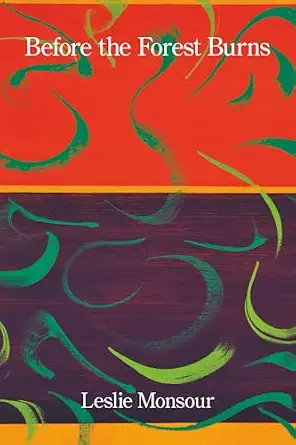
Before the Forest Burns, by Leslie Monsour. Kelsay Books, 2025.
So-called light poetry arrives in all forms. In this new collection from Leslie Monsour, you’ll find it in couplets, quatrains, and multi-page narratives, with telling details, clever rhymes, and compelling imagery. From a section of 19 poems evoking laughter, wry grins, and smiles of recognition, here’s a villanelle:
Coming to Terms Over Coffee
I’d never fall in love with you.
Love fizzles out and mortifies.
Affection’s fine, and it will do.
Besides, love’s common as bamboo
And flits about like butterflies.
How could I fall in love with you
And send you flowery billets-doux
Or hit upon you otherwise?
Affection’s fine, and it will do.
Lovers are fickle and untrue;
They tell each other little lies.
I’d never fall in love with you,
Stoop to some secret rendezvous,
And be reduced to quivering sighs:
Affection’s fine, and it will do.
So pour your famous foreign brew,
As dark and jolting as your eyes.
I’ll never fall in love with you;
Affection’s fine, and it will do.
Here’s an example of short and punchy (which first appeared in Light):
Colorless, Odorless, Tasteless
The term “inert” applies to noble gases.
It’s also aptly said of noble classes.
Especially, Monsour is a master of the sonnet, a form which can tell any story. Who has attended a poetry conference, camp, or festival without being aware of undercurrents like these?
At the Summer Poetry Festival
Ah there she is, all siren-like and fair,
Looking for blurbs, no doubt. I like her hair.
As for the manuscript she’s bandying,
I’ve heard it’s so-so, but I’ll praise the thing.
My Pulitzer and sultry, southern lilt
Routinely do the trick—she’ll all but wilt
Into my arms. I see she wears a ring.
So much the easier to have a fling.
She’s caught my gaze. I’ll raise my glass and wink.
What luck, she has my book and wants a drink.
I’ll meet her at the bar. What have we here?
Sign it for you? With pleasure, yes, my dear.
No pen? No matter. Later on we’ll go
And look for one inside my bungalow.
Tempting titles are a feature of light verse, and Monsour nails them: “Lovers and Spiders.” “Parental Misguidance.” “On Misreading a Wine Ad.” You’ll find the poem that follows that last one here.
In the thoughtful and contemplative poems comprising most of the collection, Monsour provides pleasure in sound as well as sensibility. Here’s snippet from “Desert Prayer”:
A gleaming granite ocean, bold as light
and strewn with bright, coarse stuff—a million suns,
the shells of ancient seas and modern guns—
the grand Mojave disappears at night,
its long and open syllable of air,
the breath of all that lives and dies out there. …
Monsour acknowledges her debt to Robert Frost and Emily Dickinson, to Henny Youngman in a humorous vein, to Richard Wilbur for his exemplary craft. Discover for yourself the astonishing structure of “The Lesson of the Artichoke” and the poignant quatrains of “White Christmas.”
I could say much more about this remarkable collection, but I’ll excuse myself with one of Leslie Monsour’s “Two Complaints” (also from Light):
In a Nutshell
Be wary when you hear, “Long story short.”
It means you’re going to get the full report.
I encourage you to check out the full report on Leslie Monsour’s memorable poetry in this new collection.
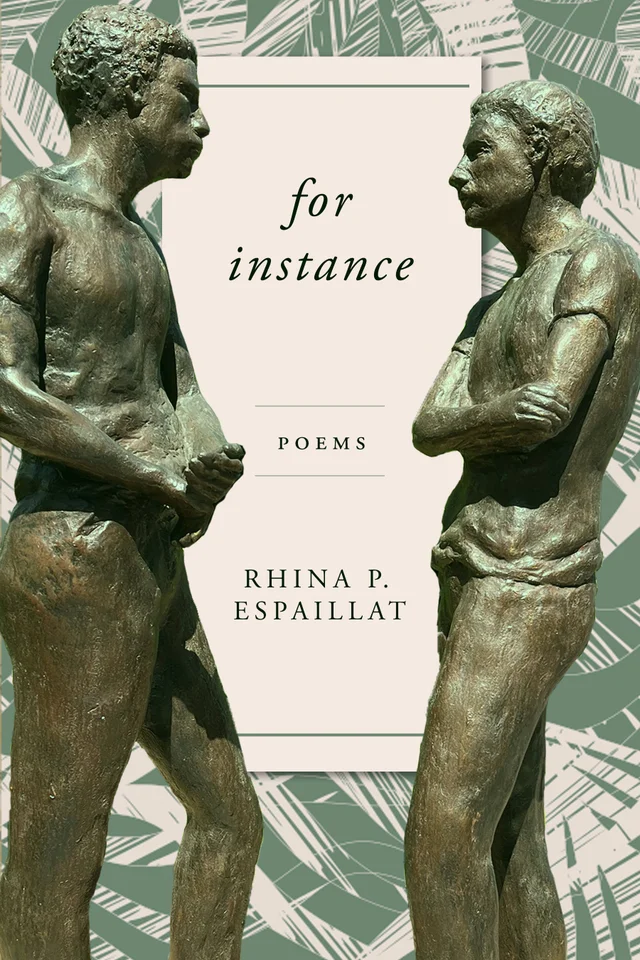
For Instance, by Rhina P. Espaillat. Wiseblood Books, 2026.
Poetry friends of Rhina P. Espaillat have a new reason to rejoice. She brings a lifetime of insight, wit, and warmth to her ninth full-length collection. Her mastery of form embraces storytelling, social consciousness, science, spiritual perception, and acute observation. No fewer than eight accomplished poets contributed eloquent praise in the opening flyleaf. I urge you to find out why.
Espaillat is well known for her sense of humor, which must have contributed to her success over several decades as a schoolteacher. That sparkling quality, along with her uncanny skill in shaping verse, brought her quick recognition when she returned to writing poetry in her later years. In For Instance, you’ll find the best work of a master.
The definition of “light verse” generally calls for cleverness in rhyme and meter, and subject matter that involves a joke, wordplay, or comic situation. Sometimes the humor emerges from a particular point of view.
Anyone in the poetry game will appreciate the drollness of “The Poet Attempts a Firm Resolve During a Long Dry Spell.” The title speaks for itself. And here’s the wry conclusion of “The Mail’s Here”:
Now this is nerve: scrawled under my pantoum—
so flawlessly composed, witty as hell—
“Time to renew again.” How’s that for terse?
Call that a fair comment on the work they read?
Are they referring to my soul, my verse,
or my subscription? Good news is what I need.
Aha! the winners’ list… and I’m not on it.
I’m going to drown myself in a deep sonnet.
The sonnet is a formalist poet’s home base. Espaillat performs the sonnet in countless variations, including one that reads from start to finish without a full stop, like “The Silken Tent” by Robert Frost. Espaillat pays homage in “Blessed”:
As soon as she accepted, they embraced;
radiant with joy, she slipped it on—the ring,
so perfectly in keeping with her taste
if not with his finances—whispering
her pleasure in his choice, and then she poked
into her sequined bag for her smart phone
while dancing witnesses slid by and joked,
smiling, at the near-groom who sat, alone
now, composing phrases for the toast
he planned to make as soon as she returned
from newsy confabs with the other coast—
parents, old friends—while he, impatient, learned—
or rather wondered—if he had been blessed
with mate or mob, or trapper’s net, or nest.
For Instance is a feast of 60 poems in 10 courses, including seven poems rendered in both English and Spanish. Clearly, Rhina has a fully-functional funny bone. However, to represent this collection more fairly, I want to conclude this review with one of her sublime lyrics.
Corot’s Meadow
Not even Echo wants to risk moving
in that cool refuge where the sun’s asleep.
Trees pour themselves on summer breezes, waving
in water shallow as the sky is deep.
A man who wants to be a meadow stirs
to his boat’s lapsing rhythm; in his hand,
perhaps a rope, a reed, or careless oars
troubling his pale reflection in the pond.
Death is like that—I promise myself so—
a gray-green lapping at the shores of sight
soft as night’s velvet whispering. But oh,
the frame’s enclosure, the muting of the light.
Observant, meditative, philosophical, witty, Rhina P. Espaillat opens our eyes to life.
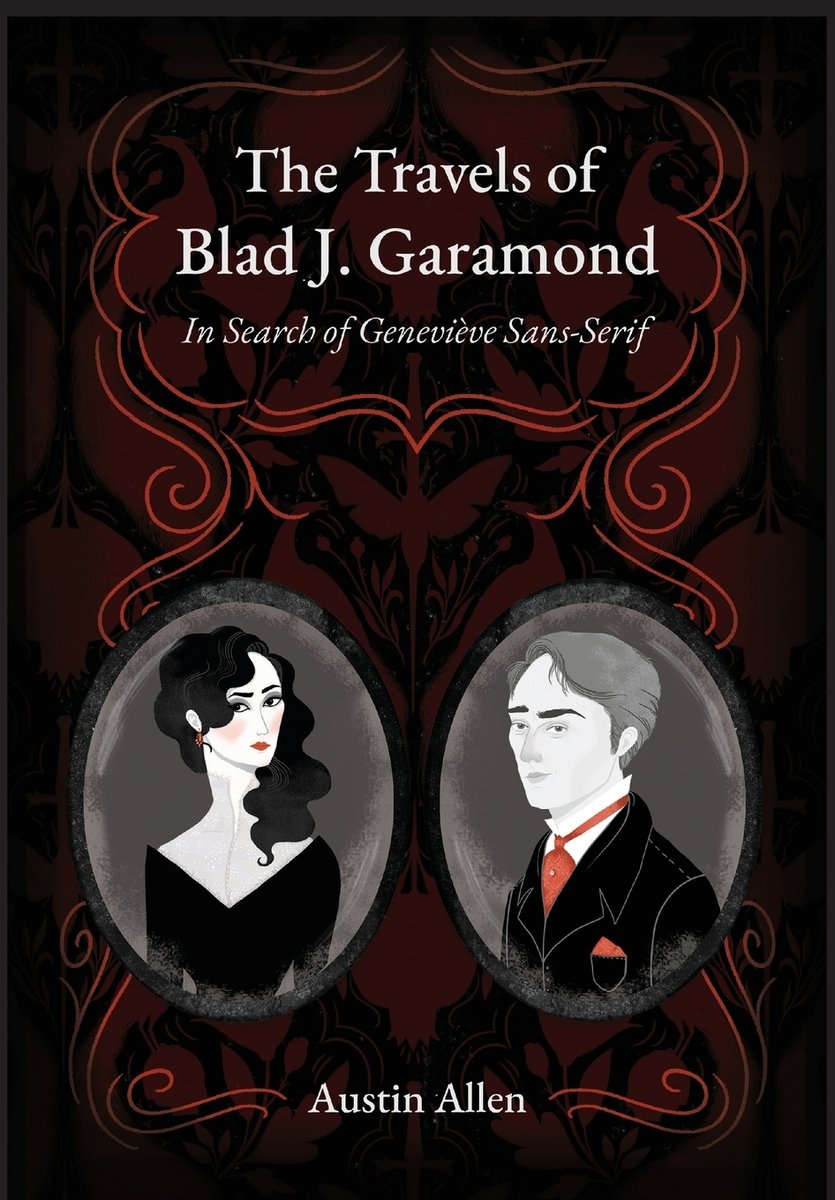
The Travels of Blad J. Garamond: In Search of Geneviève Sans-Serif, by Austin Allen. Measure Press, 2025.
I haven’t been this captivated by a tale told in poems since Vikram Seth’s 1986 novel The Golden Gate, composed entirely in sonnets. Austin Allen surpasses even that tour de force in his wondrous wanderings in both verse and adventure.
Most writers will recognize in the title references to typography. Blad, author of the letters from which these reports are selected by the “editor,” is a descendant of the type designer Garamond. Geneviève Sans-Serif, the woman Blad pursues, is a mysterious and ephemeral character in the drama.
The memoirist cautions his editor as he proposes to embark on his journeys:
Installments will be irregular and posted from around the globe. Their
ordering will be altered, or not, by the vagaries of international mail. The text
will be fragmentary owing to sharks, rapier thrusts, and revision.
The story unfolds in episodes of verse, no two poems alike in form, each one quirkily connected to the plot. You’ll be seduced by rhyming lines throughout the book, rhymes so cleverly woven that you may scarcely be aware of them until your attention snaps to every once in a while.
My usual reviewing technique of quoting examples simply won’t work. This imaginary journey is ingenious in both conception and execution and, in my view, cannot be captured in a few exemplary stanzas. However, toward the end of the story, the typography shifts to sans-serif for two pages of “the penseés” of the elusive Geneviéve. This paragraph hit the spot with me.
Writers make difficult lovers, less because of their chemical
addictions than because of their addiction to revision. It is
a short step from discarding and rewriting poetry to destroying
and rebuilding romance. The goal in each case is the same
annoying illusion: “It came to me all at once.” “It was love
at first sight.”
I can imagine the poet Austin Allen working through this creation for over 15 years, as he says, all the while reveling in the love of the many writers and others named in the Acknowledgments. You can experience the romance, and enjoy the brilliant journey, in the finished novel.
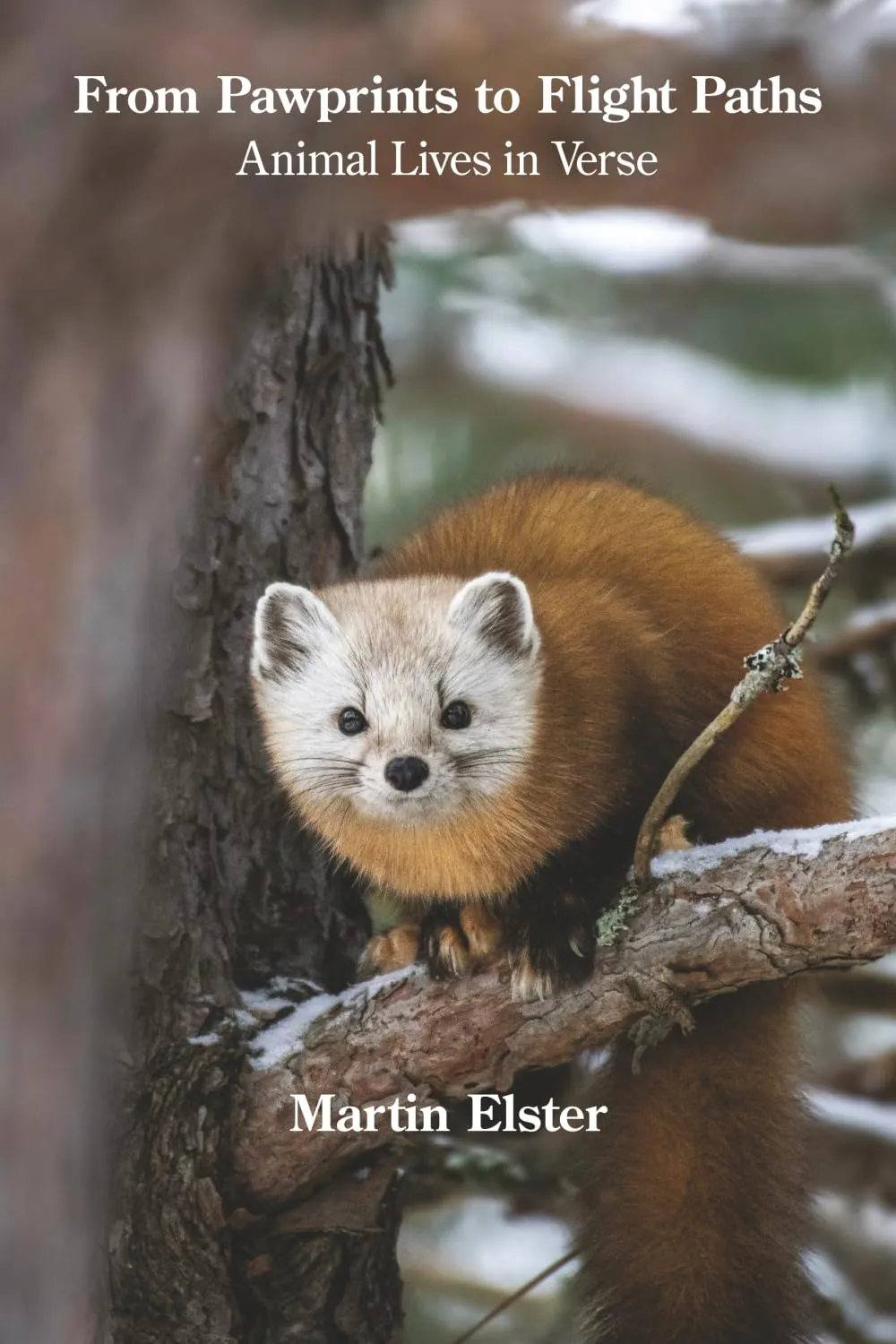
From Pawprints to Flight Paths: Animal Lives in Verse, by Martin Elster. Kelsay Books, 2025.
Martin Elster’s playful collection of poems about animals stirs up memories. Also, probably, itchy sensations. A symphony percussionist as well as a poet, Elster describes a drummer’s ordeal while rendering lengthy beats outdoors on a summer evening:
“How can he stop to scratch? His part must never
cut out. Time’s poky arrow will not hurry.
Bolero! May it live—not last—forever.”
You’ll find “The Snare Drummer’s Plight” in a section of the book comprising 16 poems about arthropods, including lovebugs, katydids, bees, crickets, and others.
As to memories, I especially noted “The Woolly Bear.” Years ago, my husband, driving at 80 mph on the interstate, would occasionally exclaim, “There’s one!” He was referring to furry black caterpillars crossing the highway. I never saw them. For years, I thought he was pushing a bad joke on me. Finally, I spotted one, squinching across the lanes at full speed (for a caterpillar). I still marvel that the species survives. As Elster observes, “… At length she will appear/a moth with coral wings—they’ll bravely bear/her through a night of bats or headlight glare/be pulverized like paper in a shredder,/or briefly flare in a world that will forget her.” I won’t.
Elster is a keen observer and scholar of the animal world. Survival is one theme of this collection. Extinction is another, along with migrations, mating rites, and environmental benefits. For example:
My Bite Is the Source of My Bark
Your Resident Beaver
Don’t fret at the sight of those trees fallen down
though it looks like a twister came thundering through!
Don’t fear! It was me! All the birches I chew
will become a fine shelter, a dam, and a town
for mallards and turtles and fishes and frogs—
and even for you….
There’s heated controversy over the beavers at Blackwater Lake, where I spend weeks in the summer. However, their role as masters of the environment is well documented.
Speaking of masters, Elster pulls out all the stops in his deployment of formal craft. In this collection, you’ll be schooled on sonnets, villanelles, terza rima, haiku, and nonce variations. His rhymes are clever and often rollicking, as in this example:
The Umbrella
Your gelatinous brolly
imparts locomotion,
propelling your body
across the wide ocean.
You’re broadly transparent,
pink, yellow, or blue.
You’re awesome. Yes, jelly,
I’m talking to you!
Tentacles under
your brolly, oh jelly,
sting legions of fish
which end up in your belly.
But today you’re not jolly.
Your brolly can’t hide
your flesh from the sun,
washed up by the tide.
As above, nature is not always favorable to the insects, fish, birds, farm animals, and domestic companions found in this book. Elster is a knowledgeable observer of their lives, from which he draws human and often humorous conclusions. Here’s a final example that captures just about everything delightful in his poetical romp through the animal kingdom:
Moving the Cows,
or, How to Dilute a Dreary Reality
It’s not just humans who can benefit from VR.
Moscow-area farmers strapped modified VR headsets
to cows to see if it improved their mood—
and, of course, their production.
—Engadget
An Alpine pasture strapped against their eyes,
they beam with joviality, they’re merry,
less moo-dy—udderly helpful for a dairy.
They do not seem to mind the frenzied flies.
They do not seem to miss their flowery meadow
though grasses do not grow in this cow ghetto.
A viridescent panoramic vista
of rolling hills and rills and songbird trills,
buttercups, daisies, clovers—all this fills
their senses, minds, and hearts. Does there exist a
heaven like that? Unfasten the technology,
and you would owe those cattle an apology
since, in their crowded shed, they’d smell the silage,
ears drenched in the din of sundry milk machines.
The sight of virile bulls in pleasing scenes,
however, is enough to cause milk spillage
inside this world of make-believe normality
where bovines browse in virtual reality.
I detect an extended metaphor here, don’t you?